Learn how TikTok Shop fulfillment from China works, including China 3PL prep, local warehouse replenishment, inventory planning, tracking and returns.
TikTok Shop Fulfillment from China: Complete Seller Guide 2026
A single viral video can change a seller’s order volume within hours. A product that normally sells 20 units a day may suddenly receive hundreds of orders overnight. At that point, the bottleneck is rarely marketing — it’s whether the inventory, warehouse and delivery system can actually keep up.
Every seller sourcing from China eventually has to answer the same operational questions: Is stock actually available? Can every order reach the carrier on time? Does valid tracking make it back to TikTok Shop? Are packaging and promotional inserts ready? And can suppliers replenish before the local warehouse runs dry?
None of this is a shipping-speed problem. It’s an inventory-location, warehouse-execution and system-integration problem — and the right setup depends heavily on the TikTok Shop market, product size, order volume and delivery requirements involved.
This guide uses TikTok Shop US as its main reference point. Platform rules vary by market and change often, so sellers should always confirm current requirements in their own Seller Center before choosing a warehouse or shipping method.
What “Fulfillment from China” Actually Means
The phrase covers three distinct operating models, and they are not interchangeable.
China direct fulfillment keeps inventory in China and ships individual orders straight to overseas buyers. Local fulfillment manufactures in China but imports in bulk to a warehouse in the destination country, where TikTok orders are then filled domestically. Hybrid fulfillment splits the job: a China 3PL manages suppliers, quality and packaging, while a local warehouse handles fast domestic delivery. For a deeper look at how China-based fulfillment works across channels, see our e-commerce fulfillment overview for Shopify, Amazon and TikTok.
One rule cuts across all three: TikTok Shop US allows third-party fulfillment providers, but sellers must retain ownership of the inventory being shipped. A seller cannot take an order and then have a separate retailer ship the product directly to the buyer. In practice, this means a compliant 3PL setup involves the seller owning stock sitting in a China warehouse, a US warehouse, or both.
| Fulfillment model |
Inventory location |
Main advantage |
Main limitation |
| China direct fulfillment |
China warehouse |
Lower upfront overseas inventory commitment |
Longer international delivery |
| Local 3PL or FBT |
Destination country |
Faster, more predictable domestic delivery |
Requires importing stock before demand is confirmed |
| Hybrid fulfillment |
China and local warehouses |
Balances delivery speed against inventory risk |
Needs a structured replenishment process |
China direct fulfillment (supplier → China warehouse → overseas customer) works well when a product suits small-parcel cross-border shipping and the target market supports it. It lets a seller hold one inventory pool in China instead of splitting stock across countries before demand is proven — useful for new products, long-tail SKUs, or brands testing several markets at once. What it cannot do is substitute for US two-day delivery, since TikTok’s domestic US shipping programs are built around US-based warehouses, not routine China-to-US parcels. For sellers combining direct fulfillment with multi-supplier sourcing, our China consolidation shipping guide explains how to coordinate staggered supplier deliveries.
Local 3PL or Fulfilled by TikTok (FBT) (supplier → US warehouse or FBT → US customer) means stock is imported in bulk ahead of orders, then picked and shipped domestically once a TikTok order comes in. FBT is TikTok’s own US fulfillment service — it stores, packs and ships eligible listings, and TikTok states its FBT network can deliver within three days for more than 80% of US orders. The trade-off is that the seller must forecast demand and commit inventory (and pay destination-country storage) before a single unit sells.
Hybrid fulfillment (Chinese suppliers → China warehouse such as HUIXIN → US 3PL or FBT → US customer) keeps some stock in China while replenishing proven sellers into the US. New SKUs, spare parts and slower-moving variants can stay in China until demand is clearer, while fast movers sit close to American buyers. For most growing brands, this is the most practical structure: the China side manages the upstream supply chain, and the US side manages platform orders and last-mile delivery. For more on how the China side of this equation works, read our step-by-step guide to the China order fulfillment process.
Why China Direct Shipping Can’t Deliver US Two-Day Speed
Two-day delivery is fundamentally an inventory-location decision, not a courier upgrade. A parcel leaving China still has to clear China warehouse processing, export handling, international transport, US import processing, domestic sorting and last-mile delivery — even on a premium express service, that chain can’t consistently match inventory that’s already sitting in a California, Texas or New Jersey warehouse.
So the real job of a China 3PL isn’t making a package fly across the Pacific overnight — it’s making sure inventory is inspected, labeled and positioned before the TikTok order is even placed. This is the distinction sellers most often miss: chasing a marginally faster international route while the actual problem is that the product is stored thousands of miles from the buyer. For a comparison of shipping lanes and transit times, see our global shipping and last-mile delivery overview.
How HUIXIN Supports the China Side of TikTok Fulfillment
This is where a China-side partner like HUIXIN comes in — not as the carrier that gets a parcel to the customer, but as the warehouse and replenishment team working upstream, before any of that happens.
A single TikTok product often involves more than one Chinese supplier: the main item from one factory, accessories from another, and branded boxes, instructions or promotional gifts from a third. HUIXIN receives all of these at one Shenzhen warehouse, logging each arrival against the customer number, PO or SKU reference — giving the seller one place to track suppliers instead of coordinating final packaging across multiple factories.
On arrival, HUIXIN can record carton quantities, condition, weight and dimensions, and upload photos for remote review. Depending on the seller’s instructions, this can extend to sampling or full inspection — checking quantity, visible defects, colors/sizes/models, accessories, and labeling. (Basic receiving is not the same as full inspection; the required scope should be agreed in advance.) Anything that fails inspection can be isolated in China, so the seller can push the supplier to repair, replace or collect it before it ever reaches an overseas warehouse — far easier to resolve while the factory is still nearby. For more on what inspection covers, see our complete guide to China quality inspection.
From there, HUIXIN can apply SKU and carton labels, assemble components into a complete TikTok bundle, add branded packaging, thank-you cards or gifts, and swap out weak or oversized supplier cartons — preparing everything to match the receiving requirements of the destination warehouse.
Finally, HUIXIN organizes replenishment into batches rather than shipping every unit overseas at once: an initial quantity moves to the US warehouse while backup stock stays in Shenzhen, and the next shipment is prepared as US stock draws down. This balances two opposite risks — running out during a viral spike, or paying to store slow-moving inventory overseas — with the goal of a repeatable cycle rather than a one-time stock dump. For more on how batch-level storage works, see our guide to flexible warehouse storage in Shenzhen.
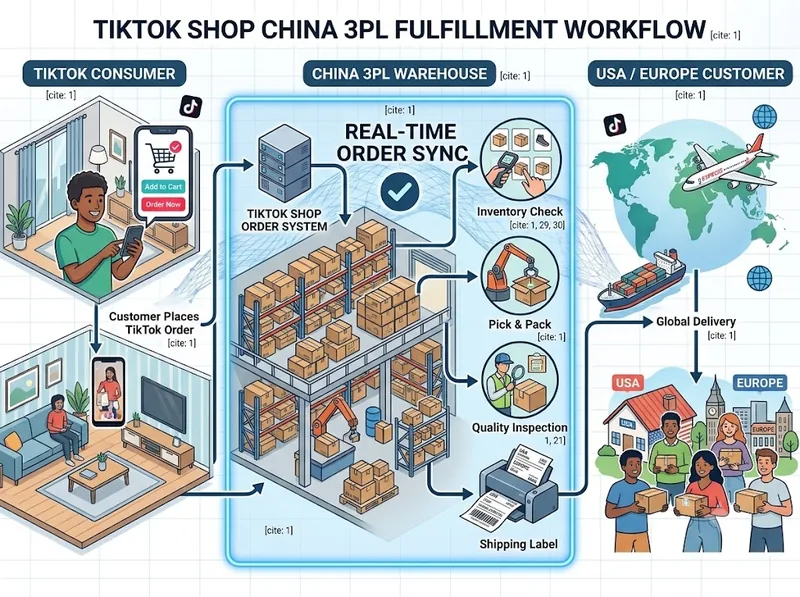 TikTok Shop China 3PL fulfillment workflow
The Fulfillment Workflow, Step by Step
1. Suppliers deliver to HUIXIN. The seller gives Chinese suppliers the warehouse address and PO/customer reference; components can arrive from different factories on different dates, and HUIXIN tracks what’s in and what’s still pending.
2. Inventory is checked against the agreed service level — basic receiving, quantity verification, sampling, or full inspection — with defective or incorrect stock isolated from approved inventory.
3. TikTok-ready inventory is prepared: approved products are labeled, organized by SKU, bundled with packaging or gifts, and finished to match the US warehouse’s inbound requirements.
4. Inventory is split by purpose — US replenishment, China safety stock, samples/creator seeding, other markets, spare parts — so the seller isn’t forced to commit every unit to one country.
5. Bulk inventory ships overseas, with HUIXIN preparing cartons, labels and inbound documents. Sea freight suits large planned replenishments; air freight suits urgent stock recovery. The cost of faster shipping should be weighed against the risk of a stockout.
6. The local warehouse receives and counts the goods, then syncs the confirmed quantity to TikTok Shop and other channels — discrepancies should be resolved before the storefront shows more stock than physically exists.
7. TikTok orders are picked, packed and handed to the carrier before the dispatch deadline. Printing a label isn’t enough — TikTok measures whether the carrier actually scans the parcel and moves it to “In Transit.”
8. Tracking flows back to TikTok Shop so the platform can score fulfillment performance and the customer can follow delivery. Manual tracking updates might work at very low volume, but they become a liability the moment a video sends in hundreds of orders at once.
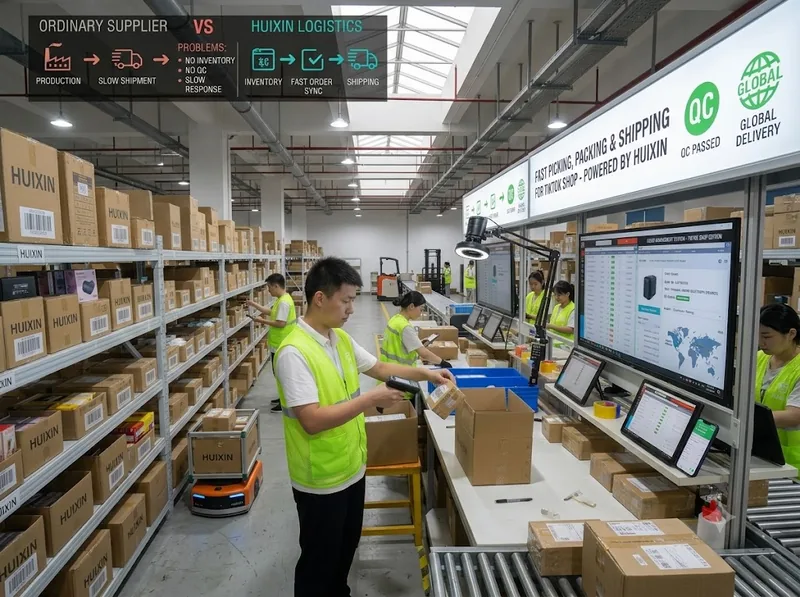 Fast picking, packing and shipping for TikTok orders at HUIXIN
TikTok Shop Metrics the Warehouse Directly Affects
TikTok Shop US scores sellers on a handful of core fulfillment metrics:
| Metric |
What it measures |
| Late Dispatch Rate |
Whether the carrier scans the parcel within the required window |
| Valid Tracking Rate |
Whether tracking numbers and carrier updates are valid |
| On-Time Delivery Rate |
Whether the order arrives within the required delivery window |
| Seller-Fault Cancellation Rate |
Whether orders are cancelled due to seller-side issues |
As of July 2026, TikTok Shop US requires a Valid Tracking Rate of at least 95%, a carrier scan within two business days of most regular orders, delivery within six business days of entering “Awaiting Shipment,” and a Seller-Fault Cancellation Rate at or below 2.5% (rules and exceptions vary by order type and can change).
These numbers aren’t abstract — they’re a direct readout of warehouse discipline. Late receiving distorts stock counts. Poor bundle mapping causes cancellations. Slow packing or a missed carrier pickup shows up as late dispatch. A TikTok integration alone can’t fix any of this; the physical warehouse still needs accurate inventory and a disciplined carrier handoff.
Planning Inventory for Viral Demand
TikTok demand doesn’t behave like a typical online store’s steady order flow — a product can sell slowly for weeks, then spike after one creator video, faster than a normal factory reorder can catch up.
Inventory planning needs to account for more than one number: stock available and in-process at the US warehouse, inventory in transit from China, backup stock at HUIXIN, supplier production still underway, and packaging or gift components. A seller with 3,000 units of the main product but only 800 branded boxes can really only sell 800 complete sets — the bottleneck is whichever component runs out first.
The right safety-stock level depends on sell-through speed, supplier lead time, China-to-US transit time, local receiving time, and any planned creator campaigns. Before a major push, it’s worth reviewing every component, not just the finished product — viral demand is better absorbed through staged replenishment than one oversized purchase order.
A Fulfillment Example: Pet-Hair Roller Set
Take a brand selling a reusable pet-hair roller through TikTok Shop. The roller body comes from a supplier in Ningbo, replacement heads from Dongguan, a small cleaning brush (the gift) from Huizhou, and branded boxes, instructions and barcode labels from Shenzhen printers.
Each supplier ships its piece to HUIXIN, which logs quantities, uploads arrival photos, and checks the roller surface, handle connection, replacement pieces and packaging against the seller’s inspection standard. The three components are then assembled into the final sales bundle — instructions added, SKU labels applied, everything boxed.
The seller sends a limited quantity to a US 3PL first, keeping the rest as backup in Shenzhen. Once creator videos start driving consistent sales and US inventory begins moving faster, HUIXIN prepares the next replenishment batch before the local warehouse hits zero — so when a video does go viral, orders keep shipping domestically without a gap.
TikTok Shop and Shopify Inventory Integration
Brands selling the same products on both TikTok Shop and Shopify ideally run one real inventory pool inside their warehouse or order-management system, so a sale on either channel updates availability everywhere.
Before scaling, it’s worth confirming: do SKU names match across platforms, how do bundles deduct their component parts, when do cancelled orders release allocated stock, when do returns become sellable again, how fast does tracking sync back to each platform, and does TikTok get priority during order spikes.
Bundle mapping is the most common failure point here. If the pet-hair roller bundle includes one main unit, two replacement heads and one brush, every sale needs to deduct all four — a system that only tracks the finished bundle SKU without touching component stock will drift out of sync. No 3PL can fix unclear product data on its own; SKU and bundle definitions need to be resolved before volume ramps up. For more on how fulfillment systems integrate with sales channels, see our China dropshipping fulfillment 3PL guide.
Returns and After-Sales
Fulfillment doesn’t end at delivery. Sellers need a destination-country return address and a defined process for inspecting what comes back. TikTok Shop US lets sellers configure return handling, but products routed through a TikTok Shop return warehouse may be destroyed rather than returned to the seller — worth understanding before selecting that option.
A working return process should define where customers send items, who inspects and photographs them, whether they can be restocked, how damaged or incomplete returns are handled, when inventory updates, and how refunds or exchanges get approved.
HUIXIN doesn’t replace a US return warehouse for American customer returns — but return data is still useful feedback upstream. If several customers report the same failure point (say, the roller handle breaking), that information can flow back to HUIXIN and the supplier to catch it in the next production run. Returns are supply-chain signal, not just a support cost.
What TikTok Shop Fulfillment Costs
Costs show up on both ends of the chain.
On the China side: supplier receiving, storage, inspection (sampling or full), labeling, kitting and branded packaging, export prep, and international replenishment shipping. HUIXIN may offer up to one month of free storage depending on product type, volume and the service agreement in place.
On the destination-warehouse side: inbound receiving, storage, pick-and-pack, packaging materials, domestic shipping, returns, and manual exception handling.
The cheapest pick-and-pack quote isn’t automatically the lowest total cost — a warehouse that’s slow to receive stock, misses carrier pickups, or ships the wrong bundle generates cancellations, platform penalties and lost sales that outweigh a small per-order savings. The number that actually matters is total cost per successfully delivered order, replenishment and returns included.
Common Fulfillment Mistakes
- Relying on China express shipping for US two-day delivery — useful for urgent replenishment, but not a substitute for local inventory.
- Waiting for a product to go viral before replenishing — by the time a video produces thousands of orders, it’s often too late to start production and transit.
- Running separate stock counts for TikTok and Shopify — this creates overselling and forces unnecessarily large safety buffers.
- Ignoring bundle components — a bundle is only sellable when every part, insert and packaging piece is in stock, not just the headline product.
- Printing labels without timely carrier handoff — a label doesn’t protect the dispatch metric if the parcel sits unscanned past the SLA.
- Skipping return planning — a return address and restocking rules need to exist before orders start shipping, not after the first return arrives.
How to Choose a TikTok Shop 3PL
For a local fulfillment warehouse, check whether it supports the relevant TikTok market, how orders enter its system, how inventory syncs across TikTok and Shopify, its cutoff and carrier pickup schedule, when tracking gets returned, how it handles order spikes and cancellations, and how it inspects and restocks returns.
For a China 3PL, check whether it can receive from multiple suppliers, what inspection services are available, whether photos get uploaded to a system, how SKU labeling and bundling are handled, whether it understands the destination warehouse’s inbound requirements, and how it plans both routine and urgent replenishment.
Don’t select a provider just because it advertises “approved,” “same-day” or “two-day” — ask specifically what inventory location, warehouse process and carrier handoff actually make that claim true. For a practical look at how fulfillment and QC work together, read our walkthrough of Shenzhen order fulfillment and QC inspection.
TikTok Shop Fulfillment with HUIXIN 3PL
Put together, HUIXIN functions as the China-side warehouse and replenishment team behind a TikTok Shop store. Suppliers, accessory makers and packaging vendors ship to one Shenzhen facility, where HUIXIN handles inbound recording, arrival photography, sampling or full inspection, SKU management, labeling, kitting, repacking and branded-bundle assembly — with photos and inspection results uploaded for remote review.
For sellers running a US 3PL or FBT setup, HUIXIN prepares inventory to match that warehouse’s inbound requirements and organizes replenishment in batches tied to actual sales demand, rather than one-off bulk shipments. Where the market and product allow it, HUIXIN can also handle cross-border small-parcel orders directly, and products with special storage or transport requirements can be accommodated when the right documentation and warehouse conditions are in place.
None of this promises impossible two-day international delivery — that was never the job. The job is making sure inspected, correctly prepared inventory reaches the right warehouse before a viral spike turns into a stockout. For the bigger picture on why Shenzhen is the right starting point, see our analysis of Shenzhen as a 3PL and fulfillment hub.
Frequently Asked Questions
Can TikTok Shop orders be shipped directly from China?
It depends on the market, seller type, warehouse setup and supported logistics method. For TikTok Shop US specifically, TikTok’s shipping program is built around US domestic warehouses, so ordinary China-to-US parcel fulfillment shouldn’t be assumed as a default option.
Does a China 3PL provide two-day US delivery?
No — it supports the upstream supply chain (receiving, inspection, packaging, replenishment). Two-day US delivery requires inventory to already be sitting in a US fulfillment warehouse.
Can HUIXIN prepare inventory for a US 3PL or FBT?
Yes — receiving from Chinese suppliers, inspection, labeling, bundling and packing to match the destination warehouse’s requirements.
How much inventory should I keep in the US?
It depends on sell-through speed, supplier production time, replenishment transit time, warehouse receiving time, and any planned TikTok promotions — enough to cover replenishment lead time without overstocking slower products.
Can TikTok Shop and Shopify share the same inventory?
Yes, when both connect to a system that supports shared inventory and SKU/bundle rules are configured correctly.
What happens when a TikTok video suddenly generates hundreds of orders?
The local warehouse fulfills from available stock while the seller checks remaining inventory and what’s incoming. In a hybrid setup, HUIXIN can release backup stock and arrange the next shipment before the local warehouse runs out.