Learn how a China consolidation shipping service works: combine multiple supplier shipments into one, save on freight costs, and manage staggered delivery timelines at a Shenzhen warehouse.
China Consolidation Shipping Service: How to Combine Supplier Shipments and Cut Freight Costs
Sourcing from several Chinese suppliers is a normal part of scaling an e-commerce business — one factory for the product, another for packaging, a third for accessories or promotional items. The trouble starts when each of them ships separately. Different production schedules, different packaging habits, different freight recommendations. Multiply that by three or four suppliers and you end up paying repeated pickup fees, minimum freight charges and destination handling costs for what is, in the end, a single order.
A China consolidation shipping service solves this by bringing everything into one warehouse before it leaves the country. Instead of four suppliers arranging four international shipments, they all deliver to the same address in China, and the warehouse takes it from there — checking, storing, repacking and combining the goods into one coordinated shipment. For a deeper look at how consolidation fits into a broader Shenzhen-based fulfillment strategy, see our guide on Shenzhen warehouse proximity and supplier consolidation.
What Is a China Consolidation Shipping Service?
A consolidation service lets goods from multiple suppliers ship to a single China-based warehouse, where each delivery is received and logged separately. Once everything needed for an order has arrived, the warehouse inspects, labels, repacks and combines it before arranging international shipping.
It’s worth separating this from LCL (less-than-container-load) shipping, which is a common point of confusion. Consolidation combines goods that belong to one customer, sourced from different suppliers. LCL combines cargo belonging to different customers inside the same sea container. The two aren’t mutually exclusive — a business might consolidate its suppliers’ goods at a warehouse first, then ship the finished cargo via LCL.
This is a commercial service, used by Amazon sellers, Shopify and TikTok Shop stores, wholesalers and brands buying from multiple Chinese manufacturers. It goes beyond basic parcel forwarding because commercial cargo typically needs inventory tracking, quality checks, export documentation and proper labelling — not just a box getting passed along. For sellers running multi-platform operations, our overview of e-commerce order fulfillment for Shopify, Amazon and TikTok explains how consolidation works alongside platform-specific fulfillment requirements.
Why Separate Supplier Shipments Cost More
Every small shipment tends to carry its own minimum charges — domestic pickup, warehouse handling, an international freight booking, destination delivery. Four suppliers shipping separately can easily mean paying four of each, even when the total product volume would qualify for much better rates as a single shipment.
Supplier packaging compounds the problem. Factories pack goods to survive the trip out of the factory, not to minimize international freight cost. A small item often ends up in an oversized carton with a lot of wasted space — and since air freight and courier services usually charge by volumetric weight (whichever is higher: actual weight or dimensional weight), that wasted space becomes wasted money.
There’s also the coordination cost that doesn’t show up on an invoice: separate tracking numbers, separate delivery schedules, and separate problems to chase down with different suppliers. Consolidation replaces all of that with one inventory record and one shipping plan.
How the Consolidation Process Works
One Warehouse Address, Multiple Suppliers
The buyer gives every supplier the same warehouse address in China, with each shipment carrying a clear reference — customer name, PO number, or supplier code. This matters more than it sounds: a busy consolidation warehouse receives cargo for many customers every day, and a carton without a reference number slows everything down.
Suppliers don’t need to finish at the same time. One factory can deliver today, another next week — the warehouse simply receives and holds each order until the full set is ready. And because only domestic delivery is required from each supplier, none of them need to arrange international freight themselves.
Receiving and Recording
Every arrival goes through a receiving check: confirming the supplier, counting cartons, checking the outer packaging, and often measuring and weighing the shipment. Photos are typically uploaded to a connected system so the customer can review arrivals remotely.
It’s worth being clear that receiving is not the same as inspection. Receiving confirms the shipment arrived intact. Verifying that the right SKUs, colors, sizes and quantities are actually inside the cartons is a separate step — and a more thorough quality inspection (checking construction, function, or appearance against a spec) is a service in its own right. It’s worth confirming with your provider exactly which of these you’re getting.
Storage While the Rest of the Order Arrives
Since suppliers rarely deliver on the same day, completed orders sit in storage until the remaining pieces catch up. This turns “chasing four factories for updates” into “checking one dashboard.” For more on how flexible storage terms support multi-supplier workflows, see our guide to flexible warehouse storage in Shenzhen.
That said, consolidation isn’t an all-or-nothing rule. If thirty cartons of fast-selling inventory are being held up by one supplier who’s two cartons short, it’s usually smarter to ship the ready stock now and fold the late items into the next shipment. Whether to wait comes down to storage cost, how urgently you need the stock, and how much the combined shipment would actually save.
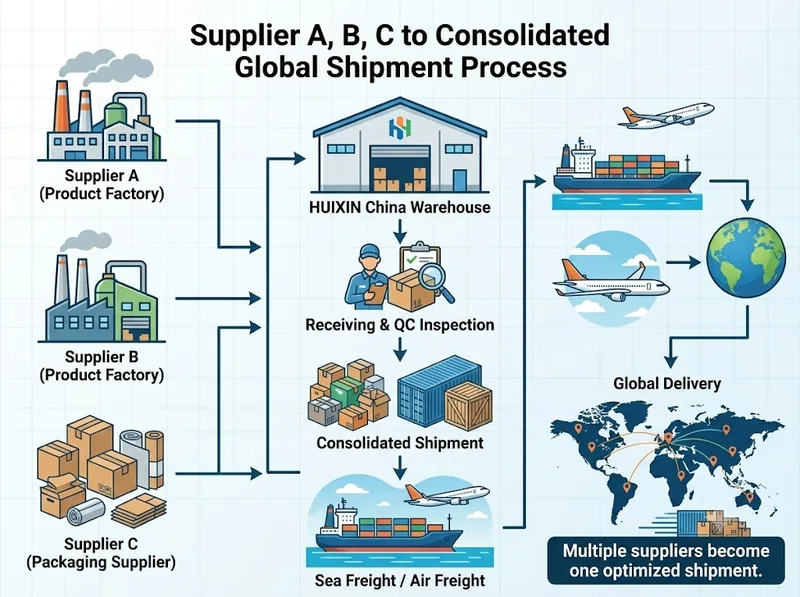 Multiple supplier shipments become one optimized shipment — consolidation cuts freight costs
Inspection, Repacking and Combining
Once everything required is in, the warehouse prepares it for international shipping — removing oversized or damaged supplier cartons, organizing products by SKU or destination, and repacking as needed. This can include bundling items into sales sets, boxing them for retail, or preparing cartons to Amazon FBA specifications.
The goal isn’t to make every carton as small as possible; it’s to balance shipping efficiency against the product still needing to survive the trip. Soft goods like clothing can often be compressed. Electronics, glass and other fragile or high-value items need the opposite — more protection, not less. Once repacking is done, the final weight and dimensions are used to compare shipping options.
Where the Cost Savings Actually Come From
Consolidation isn’t a single discount — the savings come from stacking several improvements together. Combining shipments spreads fixed minimum charges (pickup, handling, documentation) across a larger volume instead of paying them repeatedly. Removing oversized or wasteful supplier packaging cuts chargeable volumetric weight, which matters most for air freight and courier shipments. A combined shipment may also be large enough to qualify for a more economical shipping method — air or sea freight instead of several small express shipments. And one coordinated shipment simply means less duplicated communication and handling overall.
One thing consolidation does not do is lower customs duty rates — those are set by product classification, declared value, and destination-country rules, regardless of how the cargo is packed or combined.
When Suppliers Deliver at Different Times
Staggered delivery is one of the main reasons businesses use a consolidation warehouse in the first place. A finished order can sit in storage while another supplier is still in production, without the buyer needing to ask the first factory to hold their goods or ship early.
A short delay — a few days — is usually worth waiting for, since the freight saving still holds up. A longer delay changes the math: at that point it’s a question of comparing the shipping saving against the risk of running out of stock. There’s no fixed rule here; it’s a logistics decision made order by order.
Why Inspection Before Shipping Matters
The biggest value of consolidation often isn’t the freight saving — it’s catching supplier problems while the goods are still in China. If sealed factory cartons are combined and shipped without being opened, the wrong color, a missing accessory, or a damaged carton might not surface until the goods land overseas or reach a customer, at which point shipping them back can cost more than the products are worth.
Opening cartons to count, compare SKUs, check labels and photograph the contents closes that gap. When something’s wrong, the supplier can still be contacted while the goods are on hand — not after they’ve already crossed the ocean. For a complete walkthrough of how this works at the warehouse level, read our guide to order fulfillment and QC inspection in Shenzhen.
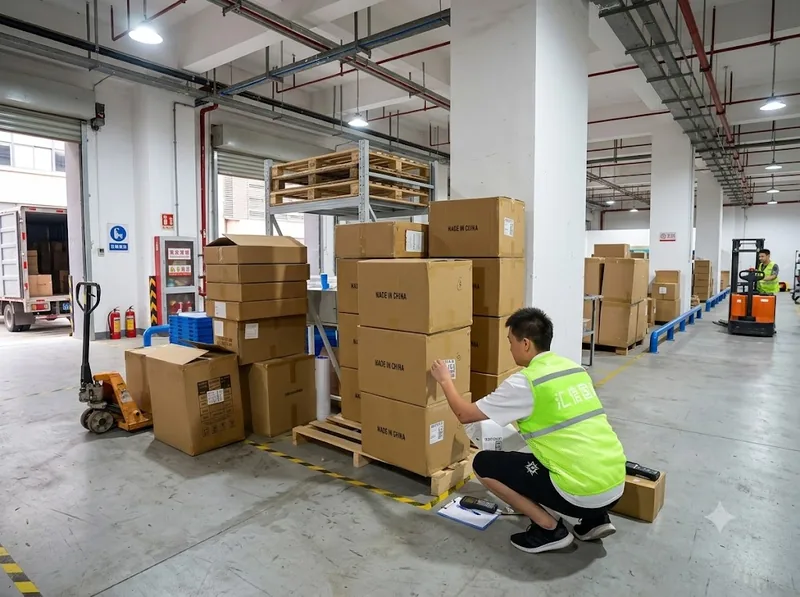 Warehouse QC and repacking at HUIXIN before international shipping
Shipping Options After Consolidation
Once cargo is checked and packed, the shipping method is chosen based on the product, destination, weight and how urgently it’s needed. Small, urgent or higher-value shipments usually go by express courier or air freight. Larger, less time-sensitive orders are often more economical by sea. Consolidated inventory can be routed to an Amazon FBA warehouse, an overseas 3PL, a business address, or shipped directly to individual customers. For a detailed comparison of available shipping lanes and delivery options, see our global shipping and last-mile delivery overview.
DDP (duties paid) shipping is popular because it puts customs clearance and final delivery in the provider’s hands, though availability depends on the destination and product category. Before choosing DDP, it’s worth confirming exactly what’s included in the quote — duties, customs examination fees and remote-area delivery charges aren’t always bundled in by default.
Amazon FBA shipments need their own preparation: box labels, FNSKU labels, correct carton dimensions and a valid shipment plan. Getting any of these wrong tends to cause delays or extra charges once the shipment reaches the FBA warehouse.
When Consolidation Isn’t the Best Option
Combining everything into one shipment isn’t automatically the cheapest choice. Urgent stock may need to move before a slower supplier order is ready. Products with batteries, liquids or magnets often need different transport routes than ordinary cargo. A supplier order that’s already large enough to fill a container is usually more efficient shipped directly, rather than routed through another warehouse first. The right call depends on the specific products and timeline — a good provider should be willing to recommend shipping separately when that’s genuinely the better option.
Example: Consolidating a Handbag Collection From Three Suppliers
Take a seller launching a new handbag line. The bags themselves come from a factory in Fujian, the retail boxes and protective packaging from a supplier in Dongguan, and small promotional gifts from a third supplier in Huizhou. Shipped separately, the seller would receive bags without their packaging, packaging without the bags, and gifts on their own timeline — leaving an overseas warehouse to sort, match and finish the packing after the fact.
Instead, all three suppliers deliver to the same Shenzhen warehouse. Handbags are received, counted and photographed on arrival. Retail boxes and packaging materials wait in storage until the promotional gifts arrive. Once everything is in, each bag is boxed, packed with its promotional gift, and labelled according to the seller’s instructions — ready to ship as a finished product rather than three disconnected supplier orders.
The point isn’t fewer cartons. It’s that the final assembly happens in China, close to the suppliers, where a missing item or packaging mistake can still be fixed before the shipment leaves.
Costs to Clarify Before You Start
A low freight quote rarely tells the whole story. Storage terms matter — some warehouses bill by carton, pallet, cubic meter or day, so it’s worth confirming the free storage period and what happens after it ends. Inspection, photography, repacking, new cartons, labelling and Amazon FBA prep are typically charged based on the labor involved, so a full inspection of every unit costs more than spot-checking samples. And on the freight side, it’s worth confirming upfront whether pickup, export handling, customs clearance, duties, insurance and final delivery are actually included in the quote — a slightly cheaper freight rate can end up costing more once these are added separately. A provider that lays all of this out clearly before goods start arriving is generally a good sign.
How to Choose a Reliable Consolidation Partner
Since a consolidation warehouse temporarily holds goods from several suppliers, reliability matters more than chasing the lowest advertised rate. Look for a provider with an actual warehouse in China, a clear process for logging incoming cargo, and the ability to share inventory updates or arrival photos. They should be upfront about the difference between basic receiving and a real quality inspection — a signed delivery receipt is not the same as someone actually counting and checking the products. Storage policies, inspection fees and repacking charges should be explained before goods start arriving, not after. And their shipping recommendations should be based on your actual product and timeline, including telling you honestly when consolidation isn’t the right move.
Why Shenzhen Works Well as a Consolidation Hub
Shenzhen sits close to the manufacturing clusters of Dongguan, Huizhou, Guangzhou and the wider Pearl River Delta, so most suppliers in the region can deliver domestically without a long haul across the country. It also connects directly to international express networks, air freight and major seaports, giving sellers flexibility between speed and cost. For e-commerce businesses in particular, where products, packaging and accessories often come from different nearby cities, a Shenzhen warehouse is a practical point to bring everything together before it leaves China. Learn more about what makes this location uniquely suited for global logistics in our analysis of Shenzhen as a 3PL and fulfillment hub.
China Consolidation Services With HUIXIN 3PL
HUIXIN 3PL runs a receiving and consolidation warehouse in Shenzhen for overseas e-commerce sellers, brands and commercial buyers sourcing from multiple Chinese suppliers. Suppliers ship directly to our warehouse, where every delivery is received, logged and photographed. We offer up to one month of free storage while the rest of an order arrives, and inspection services ranging from sampling checks to full unit-by-unit inspection, depending on what the product needs.
From there, we handle labelling, kitting, repacking and Amazon FBA preparation, and route the finished cargo through cross-border small-parcel shipping, air or sea freight, to an FBA warehouse, an overseas 3PL, or directly to your customers. Arrival and inspection photos go into a connected system so you can review and approve shipments without needing to be in China.
In short, HUIXIN acts as your warehouse and supply chain office in Shenzhen — one coordinated operation instead of a separate headache for every supplier. To get started, share your supplier locations, product details, expected quantities and destination, and we’ll put together a receiving, preparation and shipping plan that fits your order.
Frequently Asked Questions
Can I consolidate products from Alibaba, 1688 and private factories together?
Yes. Any supplier can ship to the designated warehouse as long as each delivery includes a clear customer or PO reference.
How long can my products stay in the warehouse?
Up to one month free. For large-volume or special cargo, it’s worth confirming the exact terms with your sales rep before delivery.
Can HUIXIN inspect products before they ship?
Yes — sampling inspection, full inspection, photography, SKU and quantity checks, and packaging verification are all available. It’s best to confirm the scope in advance. For more detail, see our complete guide to China quality inspection.
Can batteries or other special products be consolidated?
Often, yes, provided the correct documentation is in place and the cargo suits the storage environment. This should be confirmed before delivery.
Can consolidated goods be prepared for Amazon FBA?
Yes, including labelling, repacking, kitting and FBA-specific prep — just make sure your shipment plan and label requirements are shared beforehand. Learn more on our Amazon FBA prep service page.
Can consolidated products ship directly to end customers?
Yes. HUIXIN’s cross-border small-parcel service is built for exactly this — fulfilling individual orders from China without routing everything through an overseas warehouse first. For more on how this works across different sales channels, see our global shipping and last-mile delivery guide.