Learn how a China dropshipping fulfillment 3PL improves delivery speed, quality control, branded packaging, inventory management and profit margins.
Dropshipping from China: How a 3PL Makes It Faster and More Profitable
In a Reddit discussion about finding a reliable China dropshipping fulfillment 3PL, a European startup described a common problem: its product was made in China, orders needed to ship directly to customers worldwide, and reliability and cost mattered more than headline delivery speed.
One detail changed the calculation. The product weighed about one kilogram, but the carton measured roughly 30 × 30 × 30 centimetres. Depending on the carrier’s volumetric-weight formula, that parcel could be charged as if it weighed several times more than the product itself.
This is what many sellers underestimate. China dropshipping fulfillment isn’t simply finding someone to attach a label and hand a box to a carrier — it’s building a system that controls inventory, product quality, packaging size, branded materials and shipping routes before each parcel leaves China. Supplier-direct dropshipping can work while a store is testing its first products, but once orders become consistent, individual suppliers tend to create delays, inconsistent packaging and unreliable inventory. A 3PL doesn’t automatically make every product cheaper or faster, but it removes most of the hidden costs that make dropshipping hard to scale. For a detailed walkthrough of how fulfillment works end-to-end, see our step-by-step guide to the China order fulfillment process.
What Is a China Dropshipping Fulfillment 3PL?
A China dropshipping fulfillment 3PL stores products in a Chinese warehouse and handles individual customer orders on the seller’s behalf. Suppliers deliver inventory to the warehouse, where it’s received, checked, recorded by SKU and stored. When a customer orders through the seller’s store, the order enters the fulfillment system, warehouse staff pick and pack it, and the tracking number goes back to the seller.
This is a different job from asking a factory to ship every order itself — factories are built for batch production, not for daily order handling, live inventory updates, branded inserts and multiple shipping routes. At HUIXIN’s Shenzhen warehouse, sellers can send products, accessories and packaging materials from one supplier or several, and HUIXIN manages everything that happens between production and final delivery. It’s also worth separating sourcing from fulfillment — plenty of sellers already have reliable manufacturers and only need a 3PL to receive, inspect, store, pack and ship. For brands sourcing from multiple factories, a China consolidation shipping service can combine supplier deliveries before fulfillment begins.
Supplier-Direct Dropshipping vs. 3PL Fulfillment
The two models hand control to different parties, which shows up in how orders actually get processed:
|
Supplier-Direct Dropshipping |
3PL Fulfillment |
| Inventory model |
Zero inventory — supplier holds stock |
Low inventory — seller keeps a small safety-stock buffer at the warehouse |
| Stock confirmation |
Confirmed only after the order is placed |
Confirmed in advance; stock is already checked and stored |
| Processing speed |
Waits for the supplier to locate and prepare each unit |
Moves straight to picking and packing |
| Packaging |
Depends on whichever supplier ships that day |
One consistent, branded standard |
| Multi-supplier orders |
May arrive as several separate, mismatched parcels |
Assembled into one complete order before shipping |
The zero-inventory model keeps upfront cost low, but it also means the supplier controls stock confirmation, processing time and packaging — if an item turns out to be unavailable, the seller may not find out until after the customer has already paid. A 3PL changes this by holding a limited amount of safety stock at the warehouse ahead of time, so when an order comes in, it doesn’t need to wait on a supplier at all. This makes China 3PL dropshipping a low-inventory model rather than a truly zero-inventory one — the seller still isn’t running a warehouse or importing bulk stock overseas, but a small buffer of ready-to-ship inventory buys a lot more control over availability and speed.
How the Fulfillment Process Works
A reliable process starts before the first order ships, with the seller and 3PL agreeing on product data, SKU rules, packaging requirements and shipping restrictions in advance. From there, each supplier sends goods to the same warehouse address with a clear reference — customer code or PO number — so incoming shipments can be identified immediately. This matters most when one brand sources from several suppliers at once: a DTC brand selling a bathroom squeegee set might get the main product from Foshan, replacement silicone blades from Dongguan, a wall hook and cloth gift from Huizhou, and branded boxes from a Shenzhen printer. Under supplier-direct shipping, one factory would have to collect every component or ship an incomplete order. Through HUIXIN, each supplier just delivers its own piece, and the warehouse becomes the point where the complete set comes together.
When goods arrive, HUIXIN logs the incoming cartons, condition, weight and dimensions, with arrival photos uploaded to a connected system so the seller can review remotely. This basic receiving step isn’t the same as a real inspection — receiving confirms the shipment arrived, not that every unit inside is correct. Sampling or full inspection is a separate, optional service: for the squeegee set, that might mean checking the handle connection, the silicone edge, the wall hook and the box condition. Anything that fails gets pulled from saleable inventory while it’s still in China, where fixing a defect with the supplier costs far less than after it’s shipped. For more on what inspection covers, see our complete guide to China quality inspection.
Approved stock is then recorded and stored under its own SKU — every colour, accessory and bundle tracked separately rather than lumped together. This component-level visibility is what prevents false inventory: a warehouse holding 500 squeegee bodies but only 120 wall hooks really only has 120 complete sets ready to sell, even if the storefront shows a higher number. As orders come in through a store integration, API or agreed upload method, the system checks that the required SKU and address are valid before the order reaches the floor — which also catches configuration differences, like a standard set (squeegee plus hook) versus a premium set (squeegee, two blades, cloth and gift box) that look similar on the storefront but need different components. For platform-specific integration guidance, see our e-commerce fulfillment overview for Shopify, Amazon and TikTok.
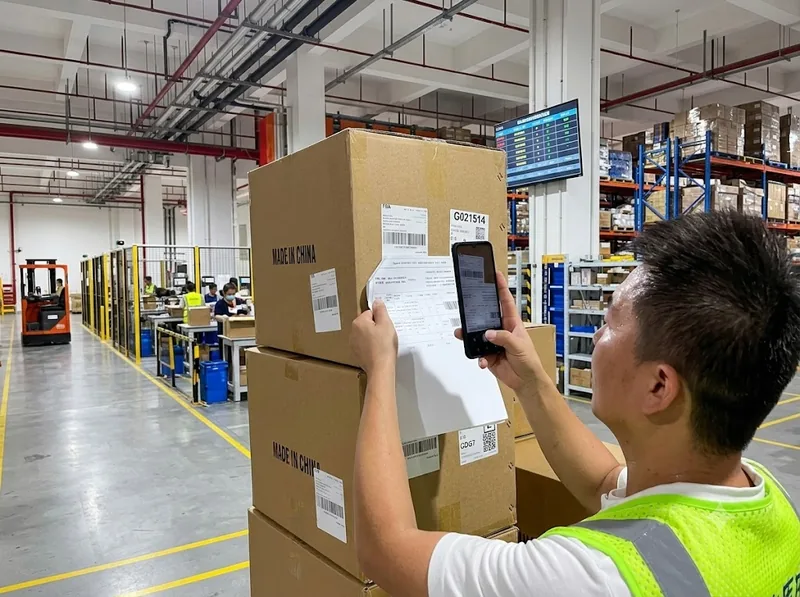 Quality inspection and custom packing at HUIXIN 3PL dropshipping fulfillment center
Picking then works the same way: staff verify SKU, quantity, colour and condition before packing, pulling anything damaged rather than shipping it — a step that protects profit as much as accuracy, since a wrong item usually means a refund or a second international shipment that costs more than the original handling fee. Packing itself has to balance three things: enough protection for international handling, a reasonable parcel size and chargeable weight, and consistent brand presentation. This is where the 30×30×30 box from the Reddit example matters — factories often size cartons for production convenience rather than parcel efficiency, and a few unnecessary centimetres can push a lightweight product into a much higher volumetric-weight bracket. HUIXIN can rework that into a fitted, branded package without sacrificing protection.
Once packed, the route is chosen based on destination, final weight, product type and required tracking — HUIXIN focuses mainly on cross-border small-parcel fulfillment for DTC brands shipping individual orders internationally, and the cheapest available line isn’t always the most profitable one if weak tracking leads to refunds and reshipments down the line. For a detailed comparison of shipping lanes, see our global shipping and last-mile delivery overview. The parcel is then labelled and declared with accurate contents and value — batteries, liquids and other regulated items may need extra documentation or a different route, which is worth confirming before the goods even reach the warehouse — and once dispatched, the tracking number goes back to the seller’s store as the parcel moves through export processing, international transit, customs and last-mile delivery.
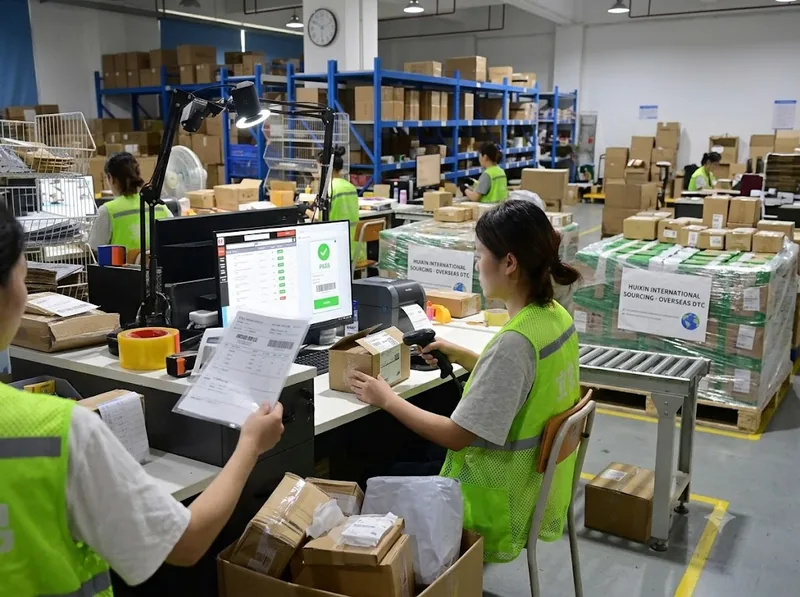 China dropshipping fulfillment warehouse processing ecommerce orders
Why It’s Faster and More Profitable
The speed gain doesn’t come from shortening the physical distance between China and the customer — it comes from removing the delays that happen before dispatch. In supplier-direct dropshipping, an order can get accepted before the supplier has even confirmed stock, and only then does someone locate, prepare and pack a single unit. With 3PL fulfillment, that groundwork is already done — product checked, labelled and sitting in storage, packaging ready — so the order moves straight into a processing queue instead of waiting on several suppliers to each prepare their piece. China fulfillment still won’t outrun a warehouse sitting next to the customer, but it’s far more predictable than coordinating supplier-direct orders one by one.
The profitability gain works the same way — not through a cheaper shipping rate, but by protecting margin in several places at once: inspection catches defects before they become refunds and complaints; repacking to control volumetric weight saves a small amount per order that adds up across volume; safety stock avoids the stockouts that waste ad spend on orders that can’t be fulfilled; SKU verification during picking cuts down wrong-item shipments; and one consistent branded package, instead of whatever mailer each supplier happens to use, supports better reviews and repeat purchases. None of these look like much on a single order — a missing accessory means one refund and one reshipment — but at scale, preventing that recurring loss is usually worth more than shaving a little off the original shipping quote.
How Much Safety Stock Should You Keep?
The goal isn’t to fill a warehouse with product that might not sell — it’s to remove supplier wait time without turning a flexible dropshipping operation into an overstocked wholesale one. New products can start with a small test quantity and scale up once demand is clear; fast-sellers justify a bigger buffer, slower ones need less. The right level depends on daily sales pace, supplier lead time, delivery time to the warehouse and any planned advertising pushes — and it’s worth planning at the component level too, since a complete set can’t ship if the main product is in stock but the wall hook or gift box has run out. For more on how storage terms work for multi-SKU inventory, see our guide to flexible warehouse storage in Shenzhen.
China Fulfillment vs. an Overseas Warehouse
The right choice comes down to where customers are and how the product ships:
|
China Fulfillment |
Overseas Warehouse |
| Best fit |
Customers spread across multiple countries |
Customers concentrated in one country |
| Delivery speed |
Standard cross-border transit time |
Fast local delivery |
| Inventory approach |
One pool serving all markets |
Bulk stock imported ahead of demand |
| Product fit |
Light, compact parcels |
Bulky or heavy items, or proven bestsellers |
| Demand certainty |
Works well while demand is still unclear |
Needs stable, forecastable demand |
China fulfillment lets a seller run one inventory pool instead of splitting stock across the US, Europe and Australia before demand is even clear — useful for products manufactured in China with customers scattered across markets. An overseas warehouse becomes the better option once demand in one market is proven and delivery speed matters more than flexibility, or when a product’s size makes cross-border parcel shipping too expensive relative to its value — exactly the situation in the Reddit example, where a low-weight but bulky item might be cheaper to import in bulk and ship locally. Many brands eventually run both: bestsellers held in key overseas markets, while new products, long-tail SKUs and smaller-market orders continue shipping from China. For a broader perspective, read our analysis of Shenzhen warehouse and 3PL advantages.
When Should You Move to a China 3PL?
Supplier-direct shipping is fine for the earliest testing stage. A 3PL becomes worth the switch once a few signals start showing up together: suppliers regularly delay dispatch or run out of stock, packaging and quality are inconsistent order to order, the product now involves several suppliers or accessories, wrong items and reshipments are eating into margin, or manual stock checks and tracking updates are taking up real time.
There’s no fixed order-volume threshold where this becomes true — it depends more on product margin and packaging complexity. A high-margin product can justify 3PL fulfillment at fairly low volume, while a low-margin item with simple packaging may not need it until volume is much higher. For the squeegee brand, that tipping point tends to arrive once the line grows past a single item — once there are replacement blades, accessories and colour variants to coordinate, a 3PL turns those separate pieces into one repeatable process.
What Does China Dropshipping Fulfillment Cost?
There’s no flat rate — the total depends on the product, inventory volume, order complexity, packaging needs and destination. Charges typically cover receiving, storage, inspection, SKU labelling, pick-and-pack, packaging materials and kitting, with custom inserts or gift assembly adding to that; HUIXIN offers up to a month of free storage, with exact terms depending on product type and volume. On the shipping side, it’s worth judging cost by total spend per successfully delivered order — including refunds, reshipments and the customer-service time bad deliveries create — rather than the shipping quote alone, since a slightly pricier route with reliable tracking often protects more margin than the cheapest line available.
How to Choose a China Dropshipping 3PL
A reliable provider should check a few boxes: a real warehouse with a clear receiving process, SKU-level inventory records with arrival updates, a clear distinction between basic receiving and actual inspection, flexible packaging and kitting for branded materials, shipping recommendations based on your actual product rather than one default route, transparent pricing across every stage, and a consistent point of contact for resolving problems. None of these matter in isolation — what they add up to is whether the provider’s process actually matches your product and markets, which is a better filter than picking whoever quotes the lowest rate. For a practical example of how fulfillment and QC work together under one roof, read our detailed walkthrough of Shenzhen order fulfillment and QC inspection.
China Dropshipping Fulfillment with HUIXIN 3PL
HUIXIN 3PL runs dropshipping fulfillment and warehousing out of Shenzhen for DTC brands, cross-border sellers and overseas businesses sourcing from China. We receive products, accessories and packaging materials from one supplier or several — inbound recording, arrival photography, sampling or full inspection, SKU management, labelling, kitting, repacking and branded-order preparation are all part of the service, with photos and inspection results uploaded to a connected system for remote review. We focus mainly on cross-border small-parcel fulfillment, picking, packing and shipping directly to your customers so you never need to run a warehouse yourself — and for a multi-supplier product like the squeegee set, that means receiving components from several cities and assembling them into one finished, branded order.
In short, HUIXIN acts as your warehouse and dropshipping fulfillment team in China — controlling product quality, inventory, packaging and delivery before each order ever reaches your customer.
Frequently Asked Questions
What is a China dropshipping fulfillment 3PL?
A logistics provider that stores products in China and processes individual customer orders — receiving inventory, managing SKUs, picking, packing and arranging international shipping.
Do I need to purchase inventory first?
Most sellers keep a limited amount of safety stock so orders can be processed without waiting on a supplier after every sale.
Can HUIXIN receive goods from multiple suppliers?
Yes — products, accessories, packaging and promotional materials can all be delivered to the HUIXIN Shenzhen warehouse and assembled into one order.
Can HUIXIN use custom packaging?
Yes, including branded boxes, inserts, thank-you cards, gifts, labels and product kitting.
How long does delivery from China take?
It depends on the destination, product type, parcel weight and dimensions, shipping route and customs conditions — there’s no single number that applies to every order.
When is an overseas warehouse better?
When most customers are in one country, fast local delivery matters most, or the product’s size makes individual cross-border shipping too expensive relative to its value.