Learn how China quality inspection works, including QC types, inspection checklist, AQL standards, costs, and how warehouse QC improves global e-commerce fulfillment.
China Quality Inspection Service: The Complete Guide for E-commerce Sellers
If you source products from China, you already know the tradeoff: great pricing and manufacturing flexibility, but very little visibility into what’s actually happening on the production line. A supplier’s sample photos can look flawless — and the mass-produced batch can still show up with the wrong color, missing accessories, crushed packaging, or parts that just don’t work.
For e-commerce sellers, that gap is expensive. It shows up as refunds, one-star reviews, and inventory you can’t sell. A China quality inspection service closes that gap by putting an independent set of eyes on your products before they ever leave the factory.
This guide walks through how China QC inspection actually works — what inspectors check, how AQL sampling standards apply, what it costs, and why more sellers are pairing inspection with warehouse-based fulfillment instead of treating it as a one-off checkpoint. For a closer look at how inspection fits into the broader fulfillment workflow, see our guide on Shenzhen order fulfillment and QC inspection services.
What Is a China Quality Inspection Service?
A China quality inspection service sends trained inspectors to check your products against your own specifications — appearance, dimensions, function, packaging, labeling, and quantity — before shipment.
Think of it as a second opinion. Most factories run their own internal QC, but a factory’s QC team is optimized for keeping the production line moving, not for catching everything a buyer would care about. Third-party quality inspection China services exist specifically to represent your standards, not the factory’s.
This is standard practice for Amazon FBA sellers, Shopify store owners, private label brands, importers, and wholesale buyers — basically anyone who can’t fly to Shenzhen to check the goods in person before they’re loaded onto a container.
Why Bother? The Cost of Skipping Inspection
The inspection fee is small compared to what a bad shipment actually costs. A single defective batch can wipe out a month of margin, especially on Amazon or Shopify, where return logistics eat into profit twice — once on the refund, once on the wasted freight. And unlike a refund, a bad review doesn’t go away: a damaged box or a missing part becomes a public review that costs future sales, not just the one order.
The economics also get worse the further a problem travels. Catching a defect in China means the supplier fixes it before you’ve paid for freight; catching the same defect after it lands in your destination warehouse means slow, expensive repairs or returns, often with no realistic way to send it back. Amazon FBA adds another layer of risk on top of that — wrong barcodes, missing labels, or non-compliant cartons can get inventory rejected outright, with extra prep fees on top.
None of this is really about any single shipment, though. It’s about consistency. Customers expect the tenth order to match the first, and inspection is how that gets enforced across suppliers and production runs — not something you can rely on the factory to do for you.
The Four Stages of Quality Inspection
Not every order needs the same level of scrutiny. Pre-production inspection happens before manufacturing starts, checking raw materials, samples, and specs — most useful for custom products or new private-label designs, where getting the input materials wrong could mean scrapping an entire run. During-production inspection happens mid-run, catching assembly or consistency problems while there’s still time to correct the line, rather than discovering the same defect repeated across thousands of finished units.
Pre-shipment inspection is the industry default. It happens after production wraps and before goods ship, using random sampling — typically AQL-based — to check appearance, function, packaging, labels, and quantity. For most sellers, this is the best balance of cost and protection. Full inspection goes further, checking every single unit instead of a sample. It’s slower and more expensive, but worth it for high-value, customized, or small-batch orders where even one bad unit matters.
What Inspectors Actually Look At
A real inspection checklist goes well beyond “does it look okay.” Inspectors work through appearance first — scratches, dents, color mismatches, uneven finishing, assembly gaps — since visible defects are what customers notice immediately. From there they measure the product against your approved specifications rather than eyeballing it, and test function: does it power on, charge, connect, or move the way it’s supposed to. Materials get checked too, mainly to confirm the supplier didn’t quietly swap in something cheaper than what was approved.
Labeling gets its own attention, since a wrong barcode or SKU can cause real warehouse problems — inspectors verify barcode accuracy, QR readability, and any warning, compliance, or country-of-origin labels. Packaging is checked for retail box condition, inner protection, sealing, and included manuals, and accessories get counted individually, since missing cables, batteries, screws, or manuals are one of the single most common customer complaints. On the shipping side, inspectors also look at carton strength, labeling, and unit count per carton, and for fragile or assembled products, they may run drop, vibration, or compression tests to simulate what international shipping will actually do to the packaging.
Good inspection companies back all of this up with photo and video evidence, which matters twice: it tells you what’s actually in the batch, and it gives you leverage if you need the supplier to fix something.
Understanding AQL: How Sampling Actually Works
AQL (Acceptable Quality Limit) is the standard sampling method used in most pre-shipment inspections. Instead of checking all 10,000 units in an order, inspectors check a statistically representative sample and use defect limits to decide whether the batch passes. AQL doesn’t promise zero defects — it defines how many defects are tolerable before a shipment is considered defective.
Defects are split into three tiers. Critical defects are safety or compliance failures — electrical hazards, missing safety components — and most buyers set this at AQL 0, meaning zero tolerance. Major defects affect function or usability, like a product that doesn’t work, the wrong model, or missing parts, and AQL 2.5 is the common standard here. Minor defects are cosmetic only — small scratches, slight color variation — and typically get a looser AQL 4.0 tolerance.
The right level depends on the product. Medical devices and other safety-critical items usually run at AQL 0/0. Private label goods and electronics commonly use AQL 1.5/2.5. Low-cost general merchandise can tolerate the looser AQL 2.5/4.0.
As an example: a seller imports 5,000 units, and the sample check turns up zero critical defects, five major defects, and eight minor defects. Whether the shipment passes depends on where those numbers fall against the agreed AQL limits — if they exceed the threshold, the batch fails and needs correction before it ships.
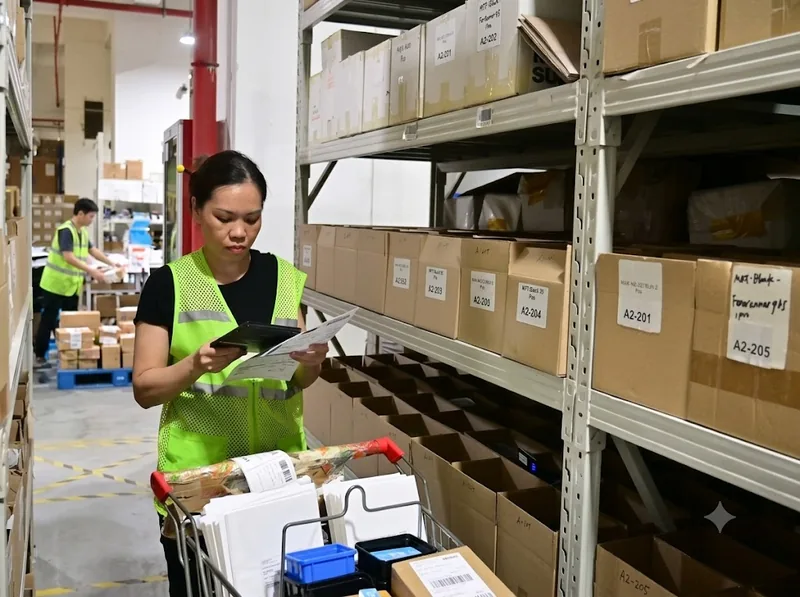 HUIXIN staff checking outbound delivery note as part of warehouse QC process
How the Inspection Process Works
The process starts with supplier preparation: you provide specs, approved samples, and quality standards, and the supplier gets the goods ready to be checked. Inspectors then visit the factory or warehouse and work through sampling, visual checks, function testing, measurements, and packaging review on-site. What comes back is a detailed report — results, defect classification, photos, and recommendations — detailed enough that you can make a shipping decision without being there in person.
If problems turn up, the supplier repairs or replaces the affected units, fixes labels, or adds missing accessories, and once the batch passes, it moves on to export prep and international transport.
The Problems Inspection Catches Most Often
Some issues show up again and again across mass production runs. Color and finish inconsistency is especially noticeable for private label brands, since customers directly compare the physical product to online photos. Physical damage — cracks, scratches, loose or poorly assembled parts — and missing accessories like cables, screws, or manuals are both common enough to expect on any given run. Label and barcode errors, like wrong SKUs, incorrect barcodes, or missing warning and origin labels, cause warehouse headaches downstream, and packaging damage — weak sealing, insufficient protection, wrong carton markings — can undo an otherwise fine product before it even reaches the customer. Mixed SKUs, where wrong colors or models get packed together, throw off warehouse counts in ways that are hard to catch later. And function failures — won’t power on, battery issues, software bugs, mechanical faults — are usually the most serious of the bunch, because they’re the hardest to explain away to a customer.
What Happens When a Shipment Fails Inspection
A failed inspection isn’t necessarily the end of the road. For minor issues, suppliers can usually repair or correct the problem and go through a quick re-check. When defects are concentrated in specific units, replacement is often simpler than repair. Either way, a re-inspection after corrections confirms the fix actually worked before the goods ship. In cases where the defects don’t meaningfully affect usability, buyers and suppliers sometimes negotiate a discount instead of a fix. Rejecting the shipment outright is the least common outcome, reserved for serious, unresolvable problems — but it’s still far cheaper than accepting defective inventory overseas.
What Does China Quality Inspection Cost?
There’s no flat rate. Product complexity matters most — a basic accessory needs far less inspection time than an electronic device requiring function and safety testing. Order size matters too, since larger batches need bigger sample sizes and more counting time. Location plays a role as well: inspectors are cheaper and easier to schedule in major manufacturing hubs like Shenzhen, Guangzhou, Dongguan, Ningbo, or Shanghai than in more remote factory locations. And any additional testing — drop tests, electrical testing, compliance checks — adds time and cost on top of a standard visual and function inspection.
Factory QC vs. Third-Party QC vs. Warehouse QC
| Method |
How It Works |
Strength |
Limitation |
| Factory QC |
Supplier inspects internally |
Fast, low cost |
The factory is grading its own work |
| Third-Party QC |
Independent inspectors check at the factory |
Objective, professional reports |
Usually a single checkpoint before shipment |
| Warehouse QC |
Products are inspected after arriving at a warehouse, ahead of fulfillment |
Combines inspection with storage and logistics control |
Requires warehouse infrastructure to run |
Factory QC is efficient but self-graded. Third-party inspection China services add independence, but typically stop once the product leaves the factory — after that, you’re on your own for storage, consolidation, and shipping coordination. Warehouse QC service closes that last gap by keeping quality control active all the way through fulfillment, not just at the factory gate. For more on how warehousing supports QC workflows, visit our warehousing and storage solutions overview.
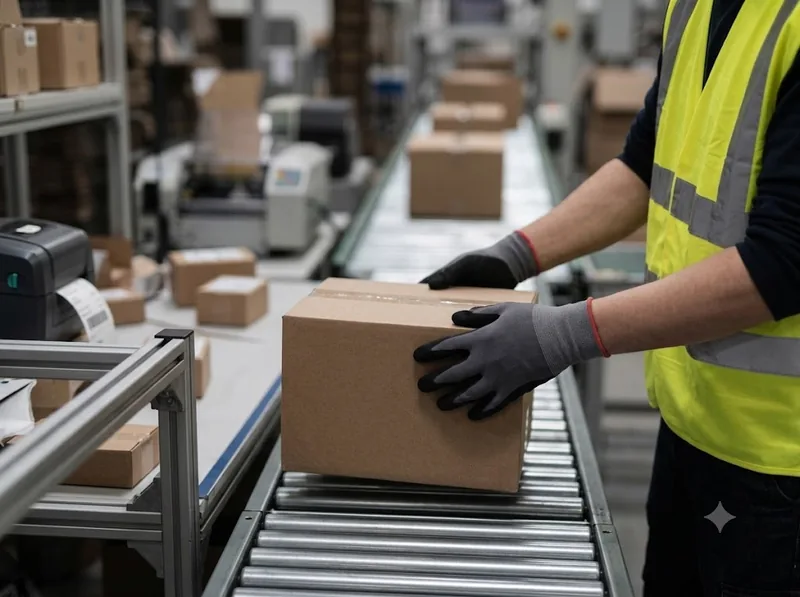 Omnichannel fulfillment warehouse at HUIXIN Shenzhen – where QC meets global logistics
Why Sellers Work With HUIXIN
HUIXIN isn’t a stand-alone inspection company — it’s a Shenzhen-based partner that combines quality inspection with warehousing and global fulfillment, so nothing falls into a gap between “inspected” and “shipped.” The workflow runs from supplier delivery to warehouse receiving, quality inspection, photo and video reporting, repacking and labeling, order consolidation, Amazon FBA prep, and finally global shipping — all under one roof.
That’s a meaningful difference for Amazon sellers, Shopify and TikTok Shop brands, wholesale buyers, and anyone juggling multiple suppliers. Instead of coordinating an inspector, a freight forwarder, and a prep center separately, one partner handles product checking, inventory management, and international fulfillment together. Learn more about how Shenzhen warehouse and 3PL services create an integrated fulfillment advantage for global sellers.
Frequently Asked Questions
Do I need quality inspection when buying from China?
For most international buyers, yes — especially for private label products, large orders, or anything sold directly to consumers, where a single bad batch is expensive to fix after the fact.
Can’t the factory just inspect the products themselves?
Most factories do run internal QC, but it’s built to serve their production process, not your standards. Independent inspection adds a check from the buyer’s side.
When should inspection happen?
Most commonly after production finishes and before shipment. For complex or large orders, it’s worth adding a during-production check too.
What does AQL 2.5 actually mean?
It sets the acceptable limit for major defects within the sample checked — one of the most widely used standards for consumer goods.
Can an inspection company check every unit instead of a sample?
Yes — that’s a full inspection. It costs more and takes longer, but it’s worth it for high-value or small-batch orders.
What happens if my shipment fails?
The supplier typically repairs, replaces, or corrects the issue, and a re-inspection confirms the fix before the goods ship.
Is warehouse QC better than factory inspection?
They solve different problems — factory inspection is about production quality, while warehouse QC adds a second layer of control after arrival, covering storage, consolidation, packaging, and fulfillment.
Does HUIXIN only do inspections?
No — HUIXIN combines China-based warehousing, quality inspection, order prep, and global fulfillment into one workflow, so sellers get a single operational partner from factory to customer.
The Bottom Line
Sourcing from China without an inspection step is a bet that mass production will match your sample perfectly, every time. It usually doesn’t. A structured inspection process — with the right AQL standard for your product — catches problems while they’re still cheap to fix.
But inspection alone isn’t the whole supply chain. Pairing it with warehouse management and fulfillment, the way HUIXIN does, means quality control doesn’t stop at the factory gate — it follows your inventory all the way to the customer.